

Shoe Width Chart & Fitting Guide (UK): What C, D & E Fit Mean
That letter next to your shoe size is a width fitting. It tells you how much room there is around the ball of your foot, the widest part, where your toes spread. Many women have never had their width measured and buy shoes on length alone, so if the letter means nothing to you, you're in good company.
The UK uses a letter scale that runs from C (narrow) and D (standard) up through E, EE and EEE, and some brands go wider still, to EEEE. D is the standard width that most high-street shoes are built on, which is why you'll rarely see it printed on the box.
If your shoes pinch across the ball or your bunion presses against the side, the length might be perfectly fine. It's the width that needs to change.
Please remember that the advice below is general, and if you are experiencing foot pain you need to see your podiatrist.
The UK women's shoe width chart: what C, D, E, EE and EEE mean
Width is the girth around your foot at the ball, the widest point just behind your toes. Each letter is a step wider than the last.
| Width letter | What it means | Who it suits |
|---|---|---|
| C | Narrow | Narrower-than-average feet, one step below standard |
| D | Standard | The average women's width; most shoes are built on this fitting |
| E | Wide | One step wider than standard; the first "wide" fitting |
| EE | Wide (some brands call it extra wide) | Two steps past standard; suits wider feet and feet with bunions |
| EEE | Extra wide | Three steps past standard; for feet broader than EE across the ball |
| EEEE | Extra extra wide | Wider again; only some brands make it, and our range stops at EEE |
The width in centimetres rises with each length size, so a size 4 E and a size 7 E are both "wide" for their length, but the size 7 measures more around. A width letter is always relative to the length.
Men's shoes use a completely different letter scale. A men's standard fitting is usually an F or a G, not a D, and the men's letters carry on up to H. If you're reading a size chart and it doesn't specify men's or women's, check which scale it's using before you assume your letter.
E and EE fittings: wide
E is the first width above standard. If your shoes feel tight across the ball in a D fitting but the length is right, E is probably where you need to be. EE is a step wider again and suits feet that are noticeably broader across the forefoot, or feet where a bunion (also known as hallux valgus) adds width at the ball.
A good example of a shoe in an EE to EEE fitting is the Calla Ava Navy Leather Court.

We've picked it because it's a classic, smart court that fits EE to EEE width feet best, with extra width and volume in the toe area, while the heel stays a standard fit so it doesn't slip. It has a 5cm kitten heel, a cushioned, arch-supported insole, and a soft kid leather upper and lining. Take a look at the Calla Ava Navy Leather Court.
You'll find more styles like this in the Calla wide fitting shoes range, all designed for women with bunions and wide feet.
EEE fitting: extra wide
EEE is the extra wide fitting, for feet broader than EE across the ball, and the widest fitting we make. If an EE shoe still feels tight over the widest part of your foot, or you have large bunions that need the extra room, EEE is the next step.
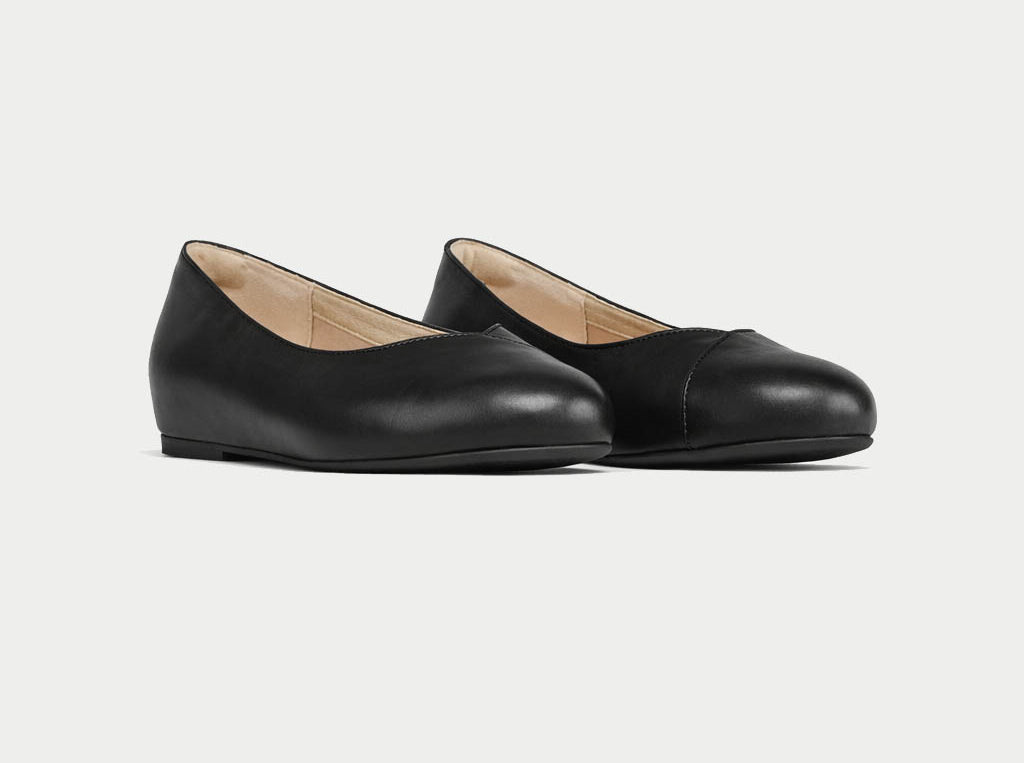
A good example of an EEE fitting shoe is the Calla Charlotte Pale Pink Leather Ballerina.

We've picked it because it's made in our widest fitting: it fits up to EEE across the toe box, and its crossover design gently stretches to accommodate your natural foot shape. It has a stretch panel across the toe box for bunions and tailor's bunions, a 1cm hidden heel, a cushioned, arch-supported insole, and a soft leather upper and lining. Have a look at the Calla Charlotte Pale Pink Leather Ballerina.
You can find all our EEE styles in the Calla extra wide fit shoes range.
At Calla, we build our shoes for feet that are wider at the front than the back, which is how most bunions change the foot's shape. If you have very severe bunions or large bunions on a very wide foot, our shoes are not the right fit for you.
Why your width letter is not a fixed standard
There is no single universal UK width standard for shoes. Length sizes already vary from one brand to another, and widths vary even more: an E fitting from one maker and an E from another can feel noticeably different on your foot.
Each brand builds its shoes on its own lasts (the foot-shaped moulds that set a shoe's proportions), and what one brand calls E width depends on their last, their construction and their target customer. There is no governing body enforcing that an E must measure a particular number of centimetres.
So if you've found that a fitting works at one brand but feels wrong at another, that's not your feet being strange. It's how width letters work. Treat a letter as a starting point and check against the specific brand's own size chart before you order.
How UK width letters compare with US shoe widths
The US and UK use different systems for shoe width, and the letters are not interchangeable. In US women's shoes the standard width is B (often shown as M, for medium), and a US D is already a wide fitting, so the same letter doesn't mean the same fit. US widths use labels like W (wide) and WW (extra wide), or letter-number codes like 2E and 4E.
On our site, Calla's EE and EEE fittings correspond to what our US store labels W and WW. But that's our convention, not a universal rule. Another brand might map those letters differently.
If you're buying from a US store, don't assume a UK letter and a US letter that look alike mean the same fit. Convert using that brand's own chart, and if they don't publish one, ask before you order.
Width versus length: two different measurements
Your shoe size number is a length measurement, heel to toe. Your width letter is a separate measurement, the girth around the ball of your foot. They're independent: you can be a size 5 with an EEE width, or a size 8 with a D.
Many women buy shoes on length alone. Width either isn't offered, isn't measured, or isn't thought about, which is why most women are in the wrong size without realising it. A review by Buldt and Menz in the Journal of Foot and Ankle Research reports one study in which 50% of women were wearing shoes too narrow for their feet (by more than 5mm), compared with 34% of men.
If your shoes feel right in length but tight across the ball, that's a width signal, not a length one. Your foot isn't too long for the shoe. It's too wide for the fitting.
Why going up a size will not add width
Sizing up a whole size is the most common fix people try when shoes pinch across the ball, and the one that works least. A longer size adds length and a bit of overall volume, but it does not add targeted width across the ball of your foot.
When you size up in length to get width, you end up with shoes that are too long. Your foot slides forward, your toes jam into the front of the shoe, and you're back to square one. The heel slips because the shoe is too long, and your forefoot still pinches because the width hasn't changed where it counts. It's a problem Mr David Gordon, the foot surgeon in our Q&A, hears about repeatedly from patients, and his answer is extra room in the right place rather than simply buying a larger shoe, without the shoe being unnecessarily loose everywhere else.
The right fix is the one most people skip: keep your correct length and choose a wider fitting instead. Your feet need width, not length.
A width fitting is not the same as toe box room
A width letter measures the girth around the ball of your foot. That's one number, and it says nothing about the shape, height or depth of the toe box, the enclosed space at the front of the shoe where your toes sit.
Two shoes with the same width letter can feel completely different across the toes. One might have a roomy toe box with plenty of space above and around the toes. The other might be the same width on paper but shallower, or more tapered, or cut in a way that presses right on the bump.
If you have bunions, you know this already. The width letter gets you in the right ballpark, but what you actually need is room where the bump sits, above and around the joint, not just girth at the widest point.
I've lived this myself. Most wide-fit brands are simply wide all over, so your foot slips out of the heel. We wanted the opposite: a shoe where the bumps stay covered and the fit stays secure. That's why shoes with a wide toe box can make more difference than a wider size on its own.
When you need width at the toe box but not the heel
If your feet are wider at the front than the back, and that's common when you have bunions, a shoe that's wide all over lets your foot slide forward. The extra room at the back does nothing for the forefoot, and you end up with blisters at the heel and pressure on the bunion at the front.
What you need is width added at the toe box while the heel stays a standard fit. That way your foot is held securely at the back and has room where it actually needs it, across the ball and over the bunion.
That's how we build our shoes. We call it the Calla Comfort Method:
- The toe box has additional width and depth, widened to EE or EEE depending on the style.
- On many styles, a Hallux stretch panel over the bunion area flexes gently as you move to reduce pressure on the joint.
- A soft lining (lamb leather on many styles) reduces rubbing.
- The heel stays a standard (D) width.
Here's how that looks on our Charlotte ballerina, seen from above:

You shouldn't have to size up to get width. You can browse our full range for bunions and wide feet to find the right style for your foot.
No shoe can cure, correct or reverse a bunion. The NHS is clear on this: you cannot get rid of bunions or stop them getting worse yourself, and only surgery changes the joint. But poorly fitting shoes can make a bunion worse over time. Foot surgeon Mr David Gordon agrees, in his Q&A on our blog, that wider-fitting, supportive shoes can reduce pressure on the bunion, but they cannot remove, correct or halt its progression. Shoes with enough room across the forefoot take the pressure off and avoid adding to it.
Which shoe width should you wear?
Three things decide your width:
- where your current shoes pinch or gape,
- the actual girth of the ball of your foot, and
- the specific brand's chart for the shoe you're buying.
If your shoes feel right in length but always tight across the ball, you need a fitting wider than the one you're in, not a longer size. If a leather pair is only slightly snug across the ball, stretching them a little can help, but it won't turn one width into the next. If they feel loose at the heel and tight at the front, you may need width at the toe box with a standard heel rather than an all-over wide fitting.
Measure your feet later in the day, when they're at their widest. Feet swell as the day goes on, and a morning measurement can leave you in a fitting that's too narrow by the afternoon. Measure standing up, too. The weight of your body will make your feet slightly wider when you're stood up than when you're sat down.
If you've never measured your width, measure your own feet: wrap a soft tape measure around the widest part of your foot, including your bunion, while you're standing, and note the figure in millimetres.

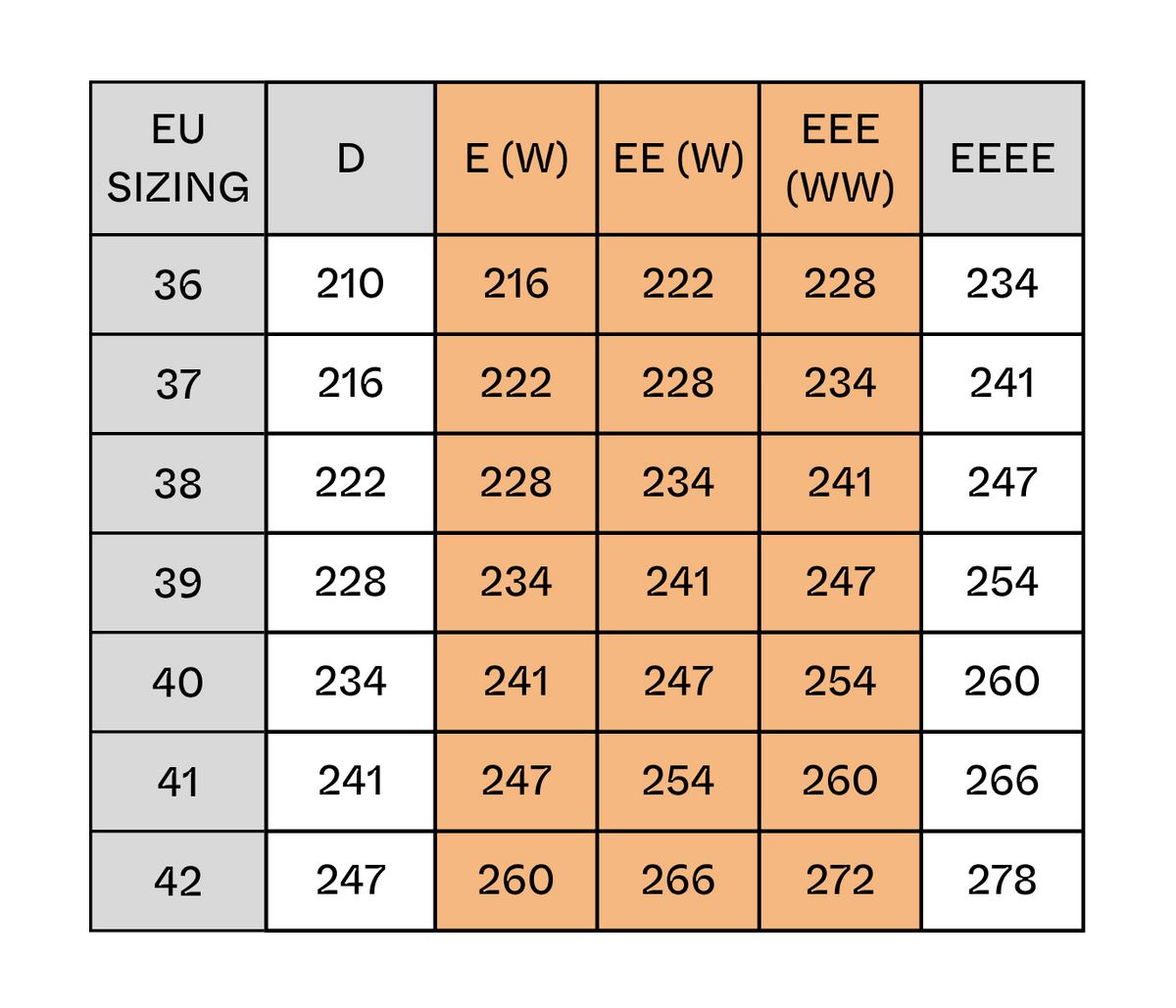
Then compare it to the brand's chart for the shoe you want. Width isn't standard across brands, and what works at one might not work at another. This is our width chart, in millimetres around the widest part of the foot:
| UK (EU) size | D | E | EE | EEE | EEEE |
|---|---|---|---|---|---|
| 3 (36) | 210 | 216 | 222 | 228 | 234 |
| 4 (37) | 216 | 222 | 228 | 234 | 241 |
| 5 (38) | 222 | 228 | 234 | 241 | 247 |
| 6 (39) | 228 | 234 | 241 | 247 | 254 |
| 7 (40) | 234 | 241 | 247 | 254 | 260 |
| 8 (41) | 241 | 247 | 254 | 260 | 266 |
| 9 (42) | 247 | 260 | 266 | 272 | 278 |
Most of our shoes fit up to EE or EEE. The D, E and EEEE columns are there to help you place your width. If your measurement falls above the EEEE column for your size, or you're not sure, get in touch with us before you order.
| Your situation | What to look for |
|---|---|
| Your shoes are tight across the ball but the length is right | A wider fitting (E or above), not a longer size |
| Wide at the front, narrow at the heel | Width at the forefoot only, with a standard-width heel |
| Your feet swell by the afternoon | An adjustable fitting (laces or straps), measured later in the day |
| You're not sure which letter you are | Measure the ball girth, then read the brand's own chart |
| Your bunion rubs against the side of the shoe | A wide toe box with room over the joint, in soft materials that won't irritate the skin |
| You wear orthotics (custom insoles) and need the existing one swapped out | A shoe with a removable footbed (the insole inside the shoe) deep enough for your own |
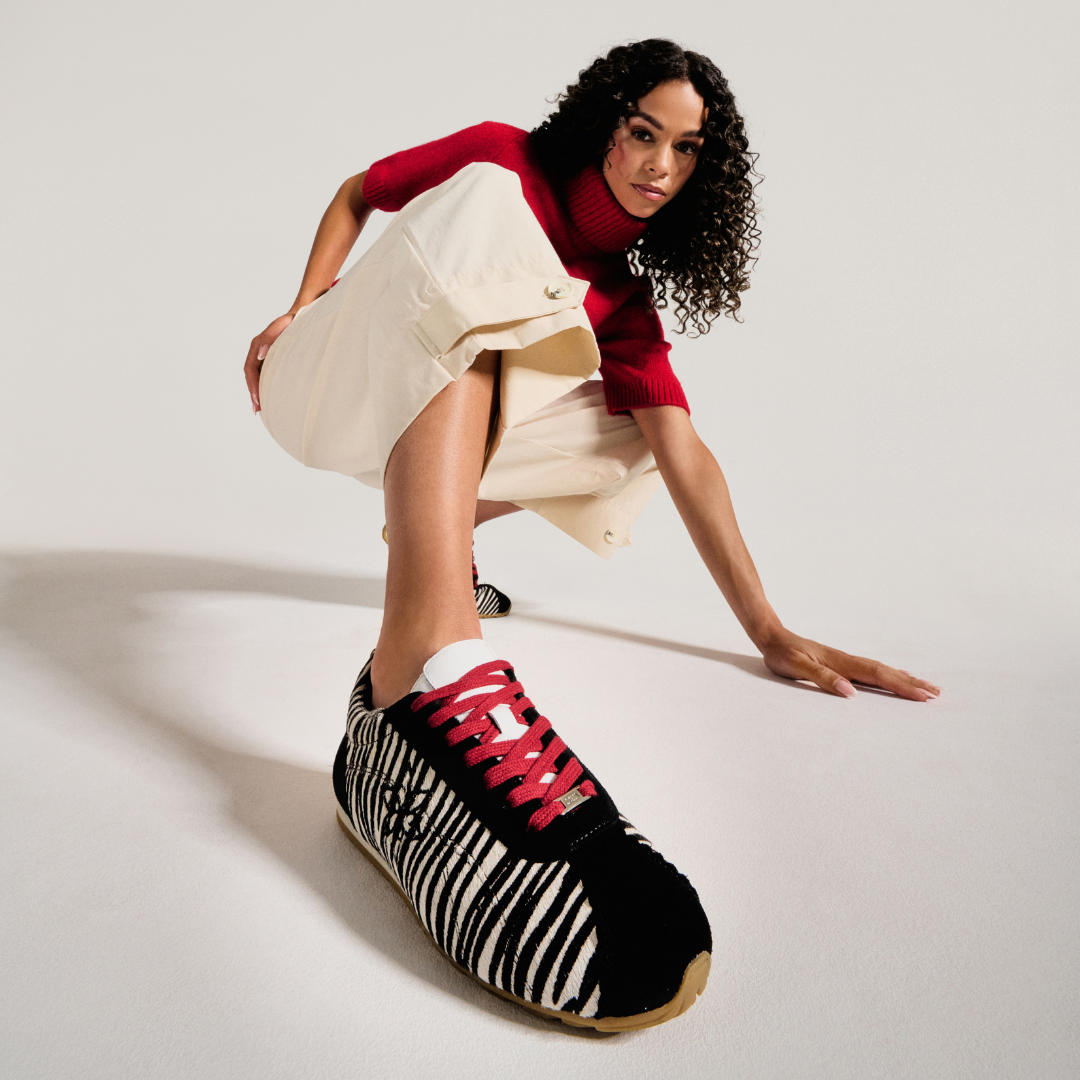
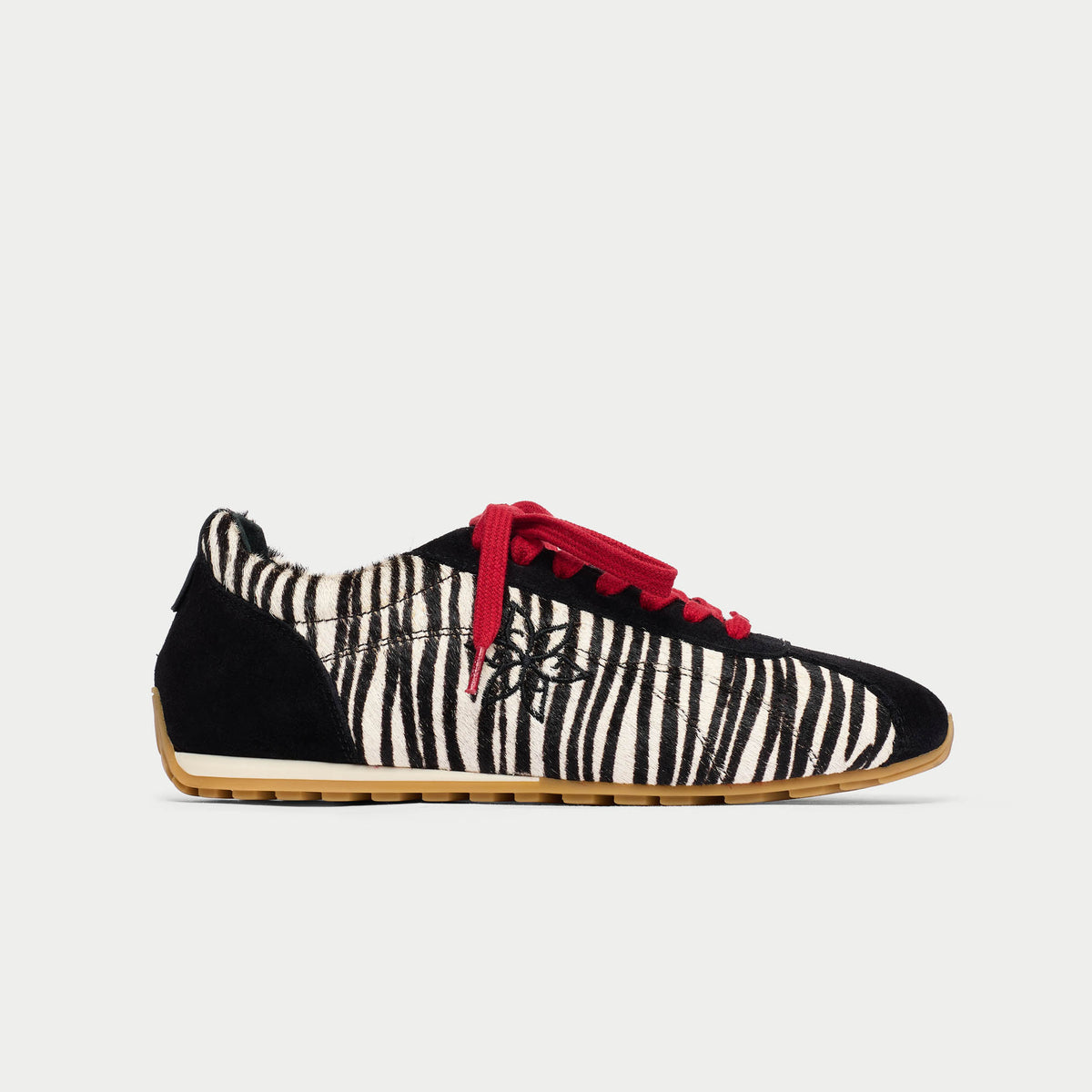
If you need adjustable width, a good example is the Calla Star White Grain Leather Trainer.

We've picked it because its laces let you open or tighten the fit across the front of your foot, so you can ease it over your bunion when you need to. It fits up to EEE, with a fully lined toe box that has no seams, and a removable moulded footbed, so you can use your own orthotics. Take a look at the Calla Star White Grain Leather Trainer.
For a smart shoe in our widest fitting, the Calla Ada Black Leather Loafer fits up to EEE across the toe box with a standard-width heel.
FAQs
Which shoe width is wider, D or EE?
EE is wider. In the women's UK scale, D is the standard width, E is one step wider (wide), and EE is two steps wider. EEE is wider again (extra wide), and a few brands go wider still, to EEEE.
What is D width in cm?
There is no single fixed figure for a D width. The measurement varies by brand and by length size, because a size 4 D and a size 8 D will have different girths even though both are "standard" for their length. On our own width chart, for example, a D fitting in a UK 6 (EU 39) measures 228mm around the widest part of the foot, and each fitting up adds about 6 to 7mm. To find yours, measure around the widest part of your foot and compare it to the specific brand's own width chart.
How wide are my feet in the UK?
Measure around the widest part of your foot, including your bunion if you have one, while you're standing, and note it in millimetres. Then compare it to a width chart for your size, like the one above. If the figure is wider than the standard (D) measurement for your length, you'll want an E fitting or above.

Leave a comment
This site is protected by hCaptcha and the hCaptcha Privacy Policy and Terms of Service apply.