Flat feet and unsupportive trainers are a miserable combination.
If your arches sit low or touch the ground entirely, you'll know the feeling: by mid-afternoon your feet ache, your ankles feel heavy, and by evening you're kicking off your trainers wondering why something so basic is so hard to get right.
It's not that flat feet are broken or wrong. Plenty of people have them with no trouble at all. But when they do cause discomfort, what your feet need is more support than most high-street trainers offer.
Supportive trainers won't rebuild a flat arch or permanently change the shape of your foot.
What they do is give your feet the structure they need while you're wearing them, which can reduce the aching and fatigue that build up through the day. That daily difference is real, even if the underlying foot shape stays the same.
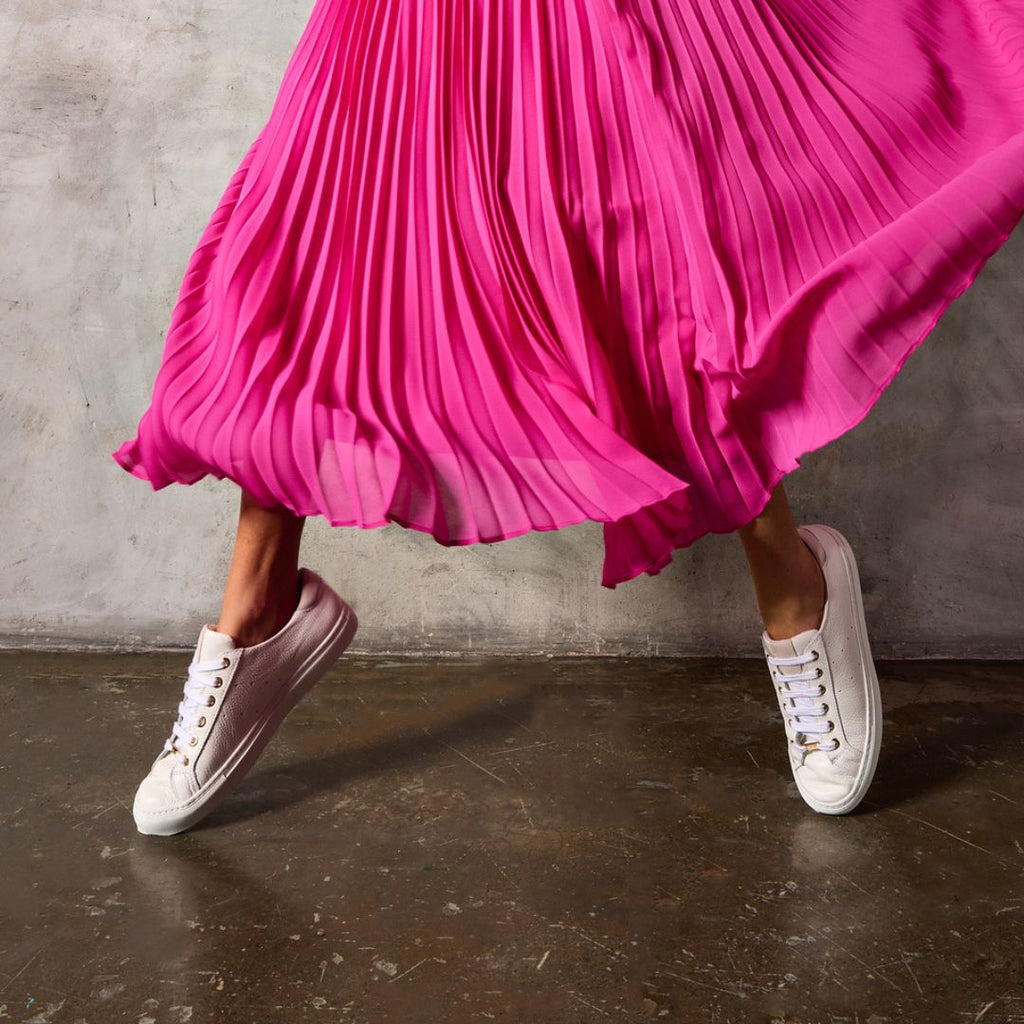
The Star trainer in smooth white leather with grey crackle accents, a cooler-toned white that leans smart and sits as well with tailoring as denim. The wider toe box gives the bunion room and the footbed lifts out for your own orthotics. Fits EE-EEE, true to size.
Origin
Handcrafted in Portugal at a family-run factory in the Porto region, designed in the UK with foot technologists
Material
Smooth white leather upper with grey crackle accents, lamb leather lining
Heel
Flat
Width cap
Fits up to EEE width
Toe box
Wider toe box, fully lined with no seams
Closure
Lace-ups so you can adjust forefoot width
Footbed
Removable moulded footbed so you can use your own orthotics, arch-supported cushioned insole
Designed for
Bunions, wide feet, hammer toes, hallux rigidus
Press
Featured by Hello, Good Housekeeping, The Independent and The London Evening Standard
Browse more images of the Star - White & Grey Leather Wide Fit Trainers:
Our Review
The white and grey Star is the one I wear when I want a trainer that looks considered with tailored trousers, since the grey crackle accents read cooler and smarter than a warm champagne. It is the same comfortable build, with a wider toe box that gives my bunion room and a footbed that lifts out for my orthotics. The grey accents also hide marks at the toe better than an all-white. I wear it with cropped trousers and a knit, or straight jeans and a blazer. True to size in a wide fit, EE-EEE.
Pros
Lace-ups let you adjust forefoot width on a daily basis
Removable footbed swaps out for prescribed orthotics
Fully lined toe box with no seams reduces friction over bunions and hammer toes
EEE width cap accommodates wider forefeet
Cons
White leather scuffs and marks more visibly than darker trainers
The Cosmos is the chunky trainer Calla's founder built because the dad-trainer trend kept squeezing her bunions, and black is the wear-with-everything one. A chunky cushioned outsole adds height, while the wider, deeper toe box and removable insole give the forefoot room and take your orthotics. Fits EE-EEE, true to size.
Origin
Handcrafted in Portugal at a family-run factory in the Porto region
Material
Black leather upper with textile side detail, lamb leather lining
Heel
Flat with chunky outsole
Closure
Lace-up
Fit
Wide fit, EE and EEE width feet, standard fit around the heel with additional width and depth in the toe box
Insole
Removable moulded footbed with arch support, swap for own orthotics
Browse more images of the Cosmos - Chunky-Sole Black Wide Fit Trainers:
Our Review
Black is the Cosmos I reach for most, because a chunky trainer usually crushes my forefoot and this one was designed by someone with bunions to do the opposite. The wider, deeper toe box means my bunion has room inside a sporty shape, and the insole lifts out for my orthotics. The chunky outsole gives me a bit of height and a lot of cushioning on hard pavements without any forefoot pressure. In black it goes with jeans, joggers or a midi without a thought. True to size in a wide fit, EE-EEE.
Pros
Chunky outsole gives lift and stride length without putting pitch through the forefoot
Removable footbed accepts the wearer's own orthotics
EEE width cap with extra toe-box depth accommodates wider forefeet and Morton's neuroma
Lace-up closure adjusts across the instep
Cons
Chunky-sole silhouette is heavier on the foot than a standard trainer profile
Leather upper needs conditioning to keep the side panels looking fresh
Sporty trainer styling means it will not slot into smart workwear or occasion outfits
The Estella is Calla's zip-up trainer with no laces to tie, and black leather is the smart everyday one. A side zip means easy on and off without bending, while the removable moulded footbed and wider fit give the bunion room and take your orthotics. Fits up to EEE, true to size.
Origin
Handcrafted in Portugal, designed in the UK
Material
Black leather upper, lamb leather lining
Heel
Flat
Width cap
Fits up to EEE width feet
Toe box
Wide toe box
Closure
Side zip instead of laces
Footbed
Removable moulded footbed, swap in your own orthotics
Press
Voted one of the best stylish trainers for wide feet by Hello, Good Housekeeping, The Independent, The London Evening Standard
Browse more images of the Estella - Black Leather Zip-Up Wide Fit Trainers:
Our Review
The black Estella is the trainer I reach for when I don't want to bend down and tie laces, because the side zip means I step straight in and out. In black leather it looks tidy enough for a casual office or smart-casual day, not just the gym. The wider fit and moulded footbed give my bunion room, and the footbed lifts out for my orthotics. The zip also means a consistent fit every time rather than laces I retie. True to size, up to EEE.
Pros
Side zip means you slip the trainer on without retying laces
Removable moulded footbed for own orthotics
EEE width fitting accommodates wider feet than most trainer brands
Black leather hides scuffs and city-pavement marks better than white
Cons
Zip is a moving part that adds a wear point lace-ups do not have
No laces means no further width adjustment beyond the fixed zip line
All-black trainer reads more formal than casual so it suits office and smart-casual wear more than sport
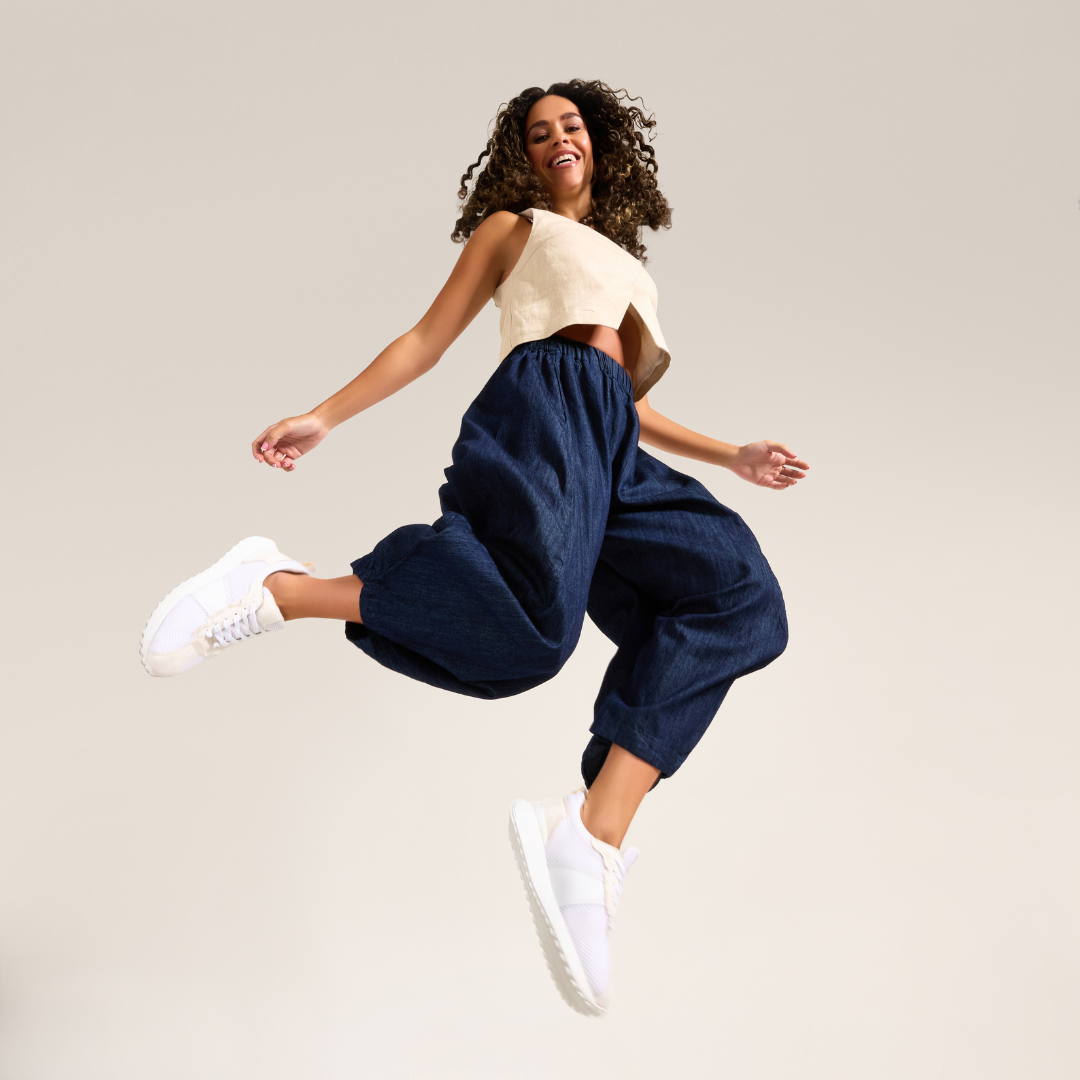
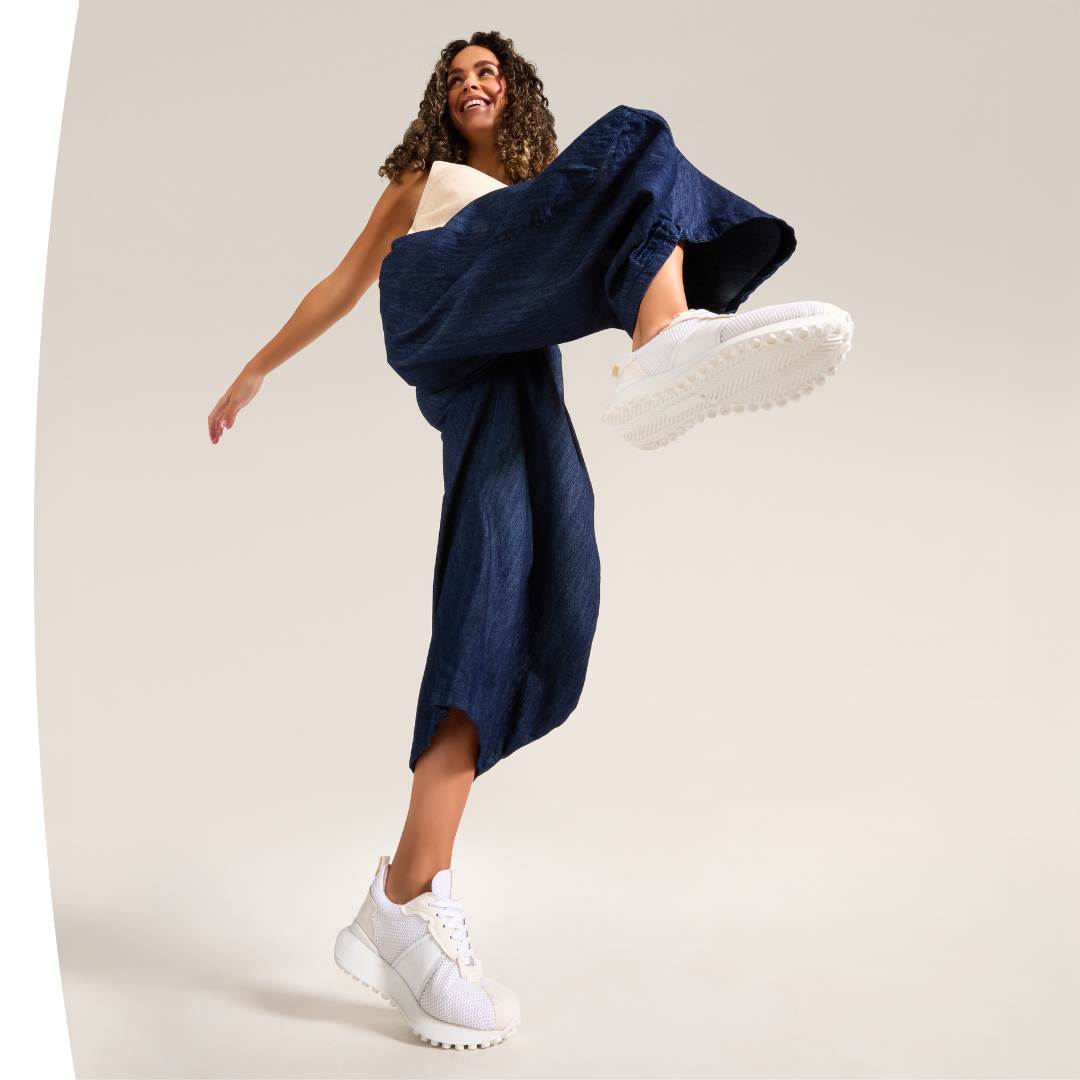
The Saturn platform trainer in clean white leather, the wearable everyday version of the platform on a 3cm sole. The platform adds even height with no heel pitch, while the wider seam-free toe box gives the bunion a smooth surface. Fits EE, true to size.
Browse more images of the Saturn - White Leather Wide Fit Trainers:
Our Review
White leather is the Saturn I reach for when I want the platform height in something that goes with everything, since white leather keeps it clean and easy where the suedes are bolder. The 3cm platform lifts me evenly without pushing my weight forward onto the bunion. The seam-free toe box stops the joint rubbing, and the laces let me adjust the forefoot. It fits an EE rather than EEE, so it suits a moderately wide foot. True to size, and white leather wipes clean easily.
Pros
Seamless lined toe box removes the stitching that usually rubs over the bunion joint
3cm platform adds height without changing the flat foot position
Laces let you loosen the forefoot independently of the heel
Fits up to EE width
Cons
White leather shows scuffs and dirt fastest of any colour
Width fitting tops out at EE so EEE feet will be tight
Lace-up means more setup than a slip-on for everyday wear
The Luna vegan trainer in white recycled canvas, the fresh version of Calla's first vegan shoe, responsibly sourced in Portugal and Italy. A removable moulded footbed takes your orthotics and a seam-free lining gives the bunion a smooth surface. Fits EE-EEE, true to size.
Origin
Materials sourced in Portugal and Italy, handcrafted in Portugal
Material
Recycled canvas upper, vegan
Heel
Flat
Fit
Fits EE and EEE width feet, standard fit around the heel with additional width and depth in the toe box
Browse more images of the Luna Vegan - White Wide Fit Trainers:
Our Review
White Luna is the vegan trainer I wear in summer, since the recycled canvas is light and the white keeps it fresh with a summer outfit. The footbed lifts out for my orthotics, and the seam-free lining means nothing rubs my bunion on a long day. The wider, deeper toe box gives my forefoot room. It is good to have a vegan option that is as supportive as the leather trainers. Fits EE-EEE, true to size, and I keep the white canvas away from mud.
Pros
Removable footbed lets the wearer swap in their own orthotics
Seamless lining reduces rubbing on sensitive feet and bunion areas
EEE width cap with extra depth accommodates wide and deep forefeet
Vegan recycled canvas upper for buyers avoiding leather
Cons
White canvas marks visibly and benefits from a fabric protector spray
Flat pitch will not suit anyone needing heel height for arch comfort
Casual trainer styling means it will not slot into formal occasion outfits
The Star trainer in black quilted leather, the quilting adding a padded diamond texture to a plain black sneaker. A fully lined seam-free toe box gives the bunion a smooth surface, while lace-ups open the forefoot to an EEE. Fits EE-EEE, true to size.
Origin
Handcrafted in Portugal at a family-run factory in the Porto region
Material
Quilted black leather upper, lamb leather lining
Heel
Flat
Colour
Black
Fit
Wide fit, fits EE-EEE width feet
Toe box
Wider toe box with extra depth, fully lined with no internal seams, standard fit around the heel
Browse more images of the Star - Black Quilted Leather Wide Fit Trainers:
Our Review
I reach for the quilted black Star when plain black feels a bit flat, because the padded diamond stitching gives the shoe some surface interest while still going with everything. The toe box is fully lined with no inner seams, so there's nothing catching on my bunion through a day of walking, and the laces let me loosen the forefoot when my foot widens later on. It keeps the standard Calla heel, so it stays secure at the back while giving my toes room at the front. I wear it with jeans or black trousers without thinking about it. True to size, EE-EEE.
Pros
Quilted leather surface adds visual texture to the standard black trainer
Removable moulded footbed accepts your own orthotic
Seam-free interior toe box reduces rubbing on the bunion joint
EE-EEE width range with laces to fine-tune the forefoot
Cons
Fit stops at EEE so EEEE width feet will not fit
Quilted stitching adds surface points that can catch on bags or trouser hems
The Cosmos chunky trainer in deep burgundy, a richer autumn alternative to black that still goes with most things. The wider, deeper toe box gives the bunion room inside a sporty chunky shape, and the removable insole takes your orthotics. Fits EE-EEE, true to size.
Origin
Handcrafted in Portugal, designed in the UK
Material
Burgundy leather upper with side detail, lamb leather lining
Heel
Flat with chunky outsole
Width cap
Fits EE and EEE width feet
Toe box
Wide and deep toe box with standard heel fit
Closure
Lace-up for adjustable forefoot width
Footbed
Removable moulded footbed with arch support, swap in your own orthotics
Browse more images of the Cosmos - Chunky-Sole Burgundy Wide Fit Trainers:
Our Review
Burgundy is the Cosmos I wear through autumn, when I want the chunky trainer in something warmer than black but just as easy to match. It sits well with denim, camel and grey, while the deep colour hides marks better than a pale sole. Inside it is the same bunion-friendly chunky shape, with a wide deep toe box that doesn't squeeze my forefoot and an insole that lifts out for orthotics. The chunky sole cushions long walks on hard ground. True to size in a wide fit, EE-EEE.
Pros
Removable moulded footbed lets you swap in prescribed orthotics
Standard heel fit with extra width and depth in the toe box means no slipping at the back while accommodating the bunion joint
EE and EEE width fitting
Chunky outsole adds height without a heel
Cons
Chunky-sole trainers sit higher off the ground so first wears take adjustment
Burgundy colour limits styling versus neutral trainer shades
Lace-up takes longer to get on than slip-on alternatives
The Saturn rides on a 3cm platform sole, and the cream-and-orange suede is its warm retro-sporty colourblock. The platform adds height with no heel pitch, while the wider seam-free toe box gives the bunion a smooth surface. Fits EE, true to size.
Origin
Handcrafted in Portugal at a family-run factory in the Porto region
Material
Cream and orange suede upper, lamb leather lining
Heel
Flat with a 3cm platform sole
Fit
True to size, fits up to EE width
Toe box
Wider toe box with seamless lining over the bunion area
Browse more images of the Saturn - Cream & Orange Suede Wide Fit Trainers:
Our Review
Cream and orange is the Saturn I wear when I want a bit of height from a trainer without a heel, because the 3cm platform lifts me evenly rather than pitching my weight forward onto the bunion. The two-tone suede has a retro, sporty look that lifts plain denim. The wider seam-free toe box means nothing rubs my bunion, and the laces let me fine-tune the forefoot. Worth knowing it fits an EE rather than going up to EEE, so it suits a moderately wide foot. True to size, and I brush the suede.
Pros
3cm platform sole adds height without a heel angle
Seamless toe-box lining means no stitching to rub the bunion joint
Lace-up lets you slacken the forefoot when feet swell
Cushioned arch-supported insole inside
Cons
Suede needs weatherproofing before wet-weather wear
Cream panels show scuffs and dirt more than darker colours
EE the width cap so EEE feet will need a different model
The Saturn platform trainer in bold teal and magenta suede, the brightest colourblock in the range on a 3cm platform sole. The platform lifts evenly with no heel pitch, while the wider seam-free toe box gives the bunion a smooth surface. Fits EE, true to size.
Origin
Handcrafted in Portugal at a family-run factory in the Porto region
Material
Teal and magenta suede upper, lamb leather lining
Heel
Flat with a 3cm platform sole
Fit
True to size, fits up to EE width
Toe box
Wider toe box with seamless lining over the bunion area
Browse more images of the Saturn - Teal & Magenta Suede Wide Fit Trainers:
Our Review
Teal and magenta is the Saturn I wear when I want the shoes to be the colour, since the bold two-tone suede turns a plain jeans-and-tee into something with a bit of nerve. The 3cm platform gives me height without tipping my weight onto my bunion the way a heel would. The seam-free toe box keeps the joint from rubbing, and the laces tune the forefoot. It fits an EE rather than EEE, so it suits a moderately wide foot. True to size, brushed to keep the colours bright.
Pros
Teal and magenta colour-block carries an outfit on its own
3cm platform lifts the foot without forefoot pitch
Seamless toe-box lining keeps stitches off the bunion joint
Lace-up lets you widen the forefoot on swollen days
Cons
Suede needs weatherproofing before wet-weather wear
Bold colour pairing is harder to match across a work wardrobe
The Estella zip-up trainer in clean white leather, the easy white you step into without tying a lace. The side zip gives quick on and off, while the wider fit and removable moulded footbed give the bunion room and take your orthotics. Fits up to EEE, true to size.
Origin
Handcrafted in Portugal, designed in the UK
Material
White leather upper, lamb leather lining
Heel
Flat
Width cap
Fits up to EEE width feet
Toe box
Wide toe box
Closure
Side zip instead of laces
Footbed
Removable moulded footbed, swap in your own orthotics
Press
Voted one of the best stylish trainers for wide feet by Hello, Good Housekeeping, The Independent, The London Evening Standard
Browse more images of the Estella - White Leather Zip-Up Wide Fit Trainers:
Our Review
White is the Estella I wear when I want a clean trainer with none of the lace-tying, since the side zip lets me step in and go. It keeps a tidy, polished look in white leather, so it works with jeans or cropped trousers. The wider fit gives my bunion room and the moulded footbed lifts out for orthotics. The zip gives the same secure fit each time without fiddling. True to size, up to EEE.
Pros
Side zip means you slip the trainer on without retying laces
Removable moulded footbed for own orthotics
EEE width fitting accommodates wider feet than most trainer brands
White leather pairs with most outfits in a way coloured trainers do not
Cons
White leather marks and scuffs faster than darker colours
Zip is a moving part that adds a wear point lace-ups do not have
No laces means no further width adjustment beyond the fixed zip line
Flat feet rarely occur alone, either. A foot that pronates inward tends to be wider across the forefoot, and that same inward roll puts extra pressure on the big-toe joint in a way that can make bunions more likely. So the trainer that works for you has to support the arch and accommodate the whole foot, not fix one thing at the cost of another.
A trainer that does both is exactly what we set out to build at Calla. Our wide-fit trainers are made with a standard-width heel and extra width across the forefoot, with a cushioned, arch-supported removable footbed, so the arch gets the support it needs while the forefoot gets the room it needs, in the same shoe.
What to look for in trainers for flat feet
Flat feet need real structure from a trainer, not just cushioning:
When your arch is flat or low, your foot tends to roll inward as it strikes the ground. That inward roll is called overpronation, and it's the reason flat feet tire faster and ache more in soft, flexible trainers. A firm midsole (the structured layer between the insole and the outer sole) resists that roll instead of collapsing with it.
An over-flexible sole might feel cushioned at first, but once you've been walking a while it offers nothing to push back against the roll, and by afternoon your feet are doing all the work.
Arch support sits on the inner side of the footbed (the moulded insole inside the shoe) and props up your arch where it would otherwise drop. You should feel it as a gentle but definite rise under your inner arch, not a rise so slight you can barely find it. A stiff, padded heel counter (the structured cup at the back that wraps around your heel) does the other half of the job: it locks your heel in place and stops it leaning inward, which is where overpronation starts.
A wide, stable base keeps the whole foot grounded. If the sole is too narrow, a flat foot can spill over the edge of the midsole, which defeats the support entirely. And a removable footbed means you can lift out the trainer's own insole and replace it with a prescribed orthotic (a corrective insert from your podiatrist, shaped to your foot) or an over-the-counter arch support, without the shoe becoming too tight or your heel lifting out of the back.
If your overpronation is particularly heavy, you may hear the terms stability and motion control floated around by foot professionals. Stability trainers suit most people with flat feet: they offer firm arch support and a structured midsole without being rigid. Motion-control trainers go further, with a stiffer build and stronger support on the inner side that physically prevents your foot from rolling. For most everyday wear, a well-built stability trainer is the better starting point.
Flexible or rigid flat feet
A flat foot is either flexible or rigid:
Flexible flat foot
Rigid flat foot
Arch when you sit or rise on your toes
Appears
Stays flat
Arch when you put weight on it
Disappears
Stays flat
How common
The more common type
Less common
What it needs
Firm arch support and a structured midsole that guide the foot through each step
Cushioning and accommodation rather than correction, because the arch isn't going to change shape under support
If you're not sure which type you have, sit down and look at the inside of your foot. If you can see a clear arch that vanishes when you stand, that's flexible. If it looks the same in both positions, it's likely rigid, and it's worth seeing a podiatrist to confirm and to talk about whether a custom orthotic would help.
Our trainers are built with additional width and depth in the toe box and a standard fit around the heel, a cushioned, arch-supported removable footbed, and seam-free linings as standard. Every pair comes with a footbed you can lift out to make room for your own orthotics.
Getting the fit right for flat feet
A roomy forefoot with the heel still held firm is the fit to aim for, because support features only work if the trainer actually fits your foot's width and shape. You need enough room across your toes and the ball of your foot that nothing is being squeezed, but a snug enough heel that your foot doesn't slide backward with every step.
Most standard trainers fall short here. A flat foot tends to be wider across the forefoot because the arch isn't lifting the midfoot up and inward, and many women end up sizing up a whole size to get the width they need. But when you size up in length to get width, you end up with trainers that are too long.
Your foot slides forward, your toes jam into the front, and you're back to square one. What you actually need is a trainer with additional width and depth in the toe box but a standard fit around the heel, not one that's been sized up all over.
Our trainers are built with up to EEE width across the forefoot and a standard-width heel, so you get the room where you need it without the slippage and heel blisters that come from sizing up. You can browse the wide-fitting range to find your fit.
A removable footbed matters here too. If you use a prescribed orthotic, the trainer needs enough internal depth to house it without your heel lifting out of the back. A shallow liner that leaves no room for an insert isn't genuinely orthotic-friendly, whatever the label says. Look for a moulded footbed you can lift out cleanly and replace with your own.
Flat feet, wide feet and bunions
Flat feet, wider forefeet and bunions tend to arrive together. The same overpronation that collapses the arch also widens the forefoot and puts extra pressure on the big-toe joint, which is why so many women who need arch support also need extra width and bunion accommodation in the same shoe.
A wide, seam-free toe box with no stitching or overlays directly over the joint accommodates your bunion and stops the rubbing that width alone doesn't fix. Plenty of wide-fit trainers give you room across your toes but still place a seam right over your bunion, and that seam is what causes the friction and soreness.
Calla solved this by moving the entire stitching line forward, away from the bunion joint, and you can't see the difference from the outside. There's more on how flat feet and bunions connect.
You will also read, more or less everywhere, that the right shoes can stop a bunion getting worse. In fact, a roomy, supportive shoe eases the pressure on your big-toe joint while you're wearing it, but nothing short of surgery corrects or reverses a bunion.
That's not a reason to avoid good trainers: reducing pressure on an irritated joint makes a real, everyday difference to how your feet feel. But it's worth knowing what shoes can and can't do, so you're making decisions based on what's actually true.
Ron McCulloch, the principal Podiatric Surgeon and Director of the London Podiatry Centre, puts it this way: 'the best one can hope for is to slow down progression and to limit the worsening of the deformity,' and only surgery can correct the underlying condition. If your bunion is painful or getting worse, please see your podiatrist.
If you have both flat feet and bunions, our guide to the best trainers for bunions looks at toe-box shape, stretch panels and finding a trainer that accommodates the joint without squeezing it.
Measuring your feet and using orthotics
Measure both feet for length and width, standing up, late in the day when your feet are at their largest. Your feet swell as the day goes on, and body weight spreads a flat foot wider than you might expect, so measuring while sitting or first thing in the morning gives you a size that will be too small by mid-afternoon.
If your feet are different sizes, fit to the larger foot. And if you use an orthotic, bring it when you're trying trainers on. A trainer with a removable footbed gives you the depth to swap in your prescribed insert, but the orthotic is thicker than the standard insole it's replacing, so you need to check that your heel is still held firmly inside the shoe once the orthotic is in place.
A removable footbed deep enough to take an orthotic, deeply moulded rather than a thin flat liner, is built for exactly this.
Our shoe size guide covers measuring your width as well as your length, which is the measurement most people skip and the one that matters most when you're fitting a wider or flatter foot.
Trainers for everyday wear and long days on your feet
A cushioned, arch-supported everyday trainer that's comfortable from morning to evening is what flat feet need for daily wear and long shifts. Extra cushioning from a thicker sole makes a noticeable difference if you're standing or walking on hard floors for hours, because flat feet don't absorb impact as efficiently as arched feet, and the fatigue builds up faster.
We designed our trainers for exactly this kind of day. Every pair comes with a removable moulded footbed on a 3cm sole, so you can swap in your own orthotics without losing the cushioned arch support underneath.
If bending to tie laces is difficult, the Estella uses a side-zip entry with laces you set once and leave.
If your feet swell through the afternoon, the Star and Cosmos give you adjustable laces and a stretch panel that moves with each foot.
And if your forefoot needs an EE width, the Saturn has it, in a shoe that looks like any fashion trainer, with the width hidden, not advertised.
A good everyday trainer is built for walking, standing and general daily life. If you run regularly or do gym training, you need a sport-specific stability or motion-control shoe designed for the forces of that activity, not an everyday trainer doing double duty. Running in an everyday trainer puts very different stresses through a flat foot, and it's worth getting properly assessed at a specialist running shop where they can look at your gait.
If long days on your feet bring on heel or arch pain, it's worth reading our guide to shoes for plantar fasciitis (inflammation of the band of tissue running along the sole of your foot, from heel to toes) here. Flat feet and plantar fasciitis often occur together, and what helps one tends to help the other.
FAQs
Do you need special shoes for flat feet?
You don't always need special shoes for flat feet. Painless flat feet that don't cause you any trouble may not need anything different. But if your feet ache after walking or standing, if your ankles roll inward, or if you tire more quickly than you'd expect, a supportive trainer with firm arch support and a structured midsole can reduce that fatigue and discomfort noticeably. Flat feet aren't a problem in themselves. The support is for the days when discomfort sets in.
For flat feet that need that daily support, we build every trainer with a cushioned, arch-supported insole and a removable moulded footbed on a 3cm sole, so the structure is there and the shoe still looks like something you chose. You'll find the same across our full range in our guide to shoes for flat feet here.
What shoes do podiatrists recommend for flat feet?
Stable, supportive shoes with firm arch support, a stiff heel counter, a wide base and room for orthotics are a sensible choice for flat feet. Ron McCulloch, the principal Podiatric Surgeon and Director of the London Podiatry Centre, advises simply 'to wear good shoes with a round toe and a relatively low heel,' which is sound general guidance whether your concern is flat feet, bunions or both.
For heavier overpronation, motion-control shoes with a more rigid structure do more to hold the foot against the roll. If your flat feet are causing pain, a podiatrist can assess whether a custom orthotic would help. Please remember that this advice is general, and if you are experiencing foot pain you need to see your podiatrist.
Which shoes should you avoid if you have flat feet?
Flat, flimsy, unsupportive shoes are the ones that will leave flat feet at their worst:
Thin ballet flats with no arch structure
Flip-flops
Unstructured plimsolls with a flat rubber sole and a canvas upper that offers nothing
Any very soft, bendy trainers that collapse completely when you twist them
The common thread is no arch support and no heel hold. Without those, a flat foot rolls inward unchecked and tires quickly.
Choosing supportive shoes no longer means accepting a look that feels 'orthopaedic,' either. Calla trainers keep their support on the inside, hidden, not advertised, so from the outside they look like any fashion trainer.
Are barefoot shoes good for flat feet?
For painful or overpronating flat feet, barefoot shoes usually aren't the best choice. Barefoot and minimalist shoes are zero-drop (the heel and toe are at the same height) with no built-in arch support, which is the opposite of what an overpronating flat foot typically needs. They're sometimes sold for bunions on the strength of their wide toe boxes, but you can get a roomy toe box with arch support and a structured sole without giving those up.
If you do want to try barefoot shoes, introduce them very gradually and ideally with guidance from a podiatrist, because going from a supportive shoe to a zero-drop one overnight puts sudden stress on tendons and ligaments that aren't conditioned for it.
How can you tell if you have flat feet?
The simplest way to tell if you have flat feet is the wet footprint test. Step out of the bath or shower onto a dry, flat surface and look at the print your foot leaves. A foot with a typical arch leaves a print with a clear curve inward along the middle. A flat foot leaves a full, wide print with little or no curve, because the arch is touching the ground.
Other signs include your ankles visibly rolling inward when you stand, and the inner edges of your shoe soles wearing down faster than the outer edges. A podiatrist can confirm whether your flat feet are flexible or rigid and advise on the best support for your particular foot.




Leave a comment
This site is protected by hCaptcha and the hCaptcha Privacy Policy and Terms of Service apply.